Someone Knew: How Prediction Markets Priced the Maduro Raid Before the News Broke
On January 3, 2026, US forces captured Nicolás Maduro in a secret raid. On a public betting site, you could watch the event being priced for a full month — while the news stayed silent. Here is what the data shows, in plain language.
By Andrés Azqueta-Gavaldón, Borja Ureta
In the predawn hours of January 3, 2026, US special forces captured Venezuelan president Nicolás Maduro in a secret raid — "Operation Absolute Resolve." The President announced it that morning.
A few months later, a US Army sergeant was charged with betting on that operation using classified information. According to the Justice Department, he turned about $33,000 into roughly $409,881 on the betting site Polymarket — the first time the US has prosecuted insider trading on a prediction market.
That is a striking story on its own. But it points at something bigger, and stranger: on a public website, anyone could watch a secret operation being priced in — for a full month — while the news said nothing. This is the plain-language version of what we found when we looked at the data.
The one-sentence version: A public betting market carried a real, moving chance that Maduro would be gone — between 8% and 27% — from early December through January 2, while our six-channel news monitor recorded almost no Venezuela coverage at all. The market was ahead of the news. And the earliest, cheapest, most concentrated bets landed on the exact deadline the raid would beat.
First, how the betting works
Polymarket is a website where people bet on yes/no questions about the future — "Will Maduro be out by January 31?" Each bet is a real trade recorded on a public blockchain, so the entire history is permanent and visible to anyone.
The price is the crowd's odds. If "Maduro out" trades at 7 cents, the crowd thinks there's about a 7% chance. A "yes" share pays $1 if it happens and nothing if it doesn't — so buying at 7 cents is a small bet on a big payout, the shape you'd expect from someone who thinks the crowd is wrong.
Keep that in mind: a "cheap yes" bet is someone paying a little for a lot, on something everyone else thinks is unlikely.
A raid nobody was reporting — except the market
For a full month before the raid, the "Maduro out by January 31" contract sat at a real, elevated level — bouncing between roughly 8% and 27%. That is not noise; it is a month of live money saying this could happen.
Over that exact same stretch, our monitor of six news and open-source channels — Bellingcat, Reuters World, BBC World, and three others — recorded essentially zero Venezuela coverage. And that silence was real: the administration has since confirmed it asked news organizations to keep the operation quiet. There was no public signal to miss. The market was pricing something the public couldn't read anywhere.
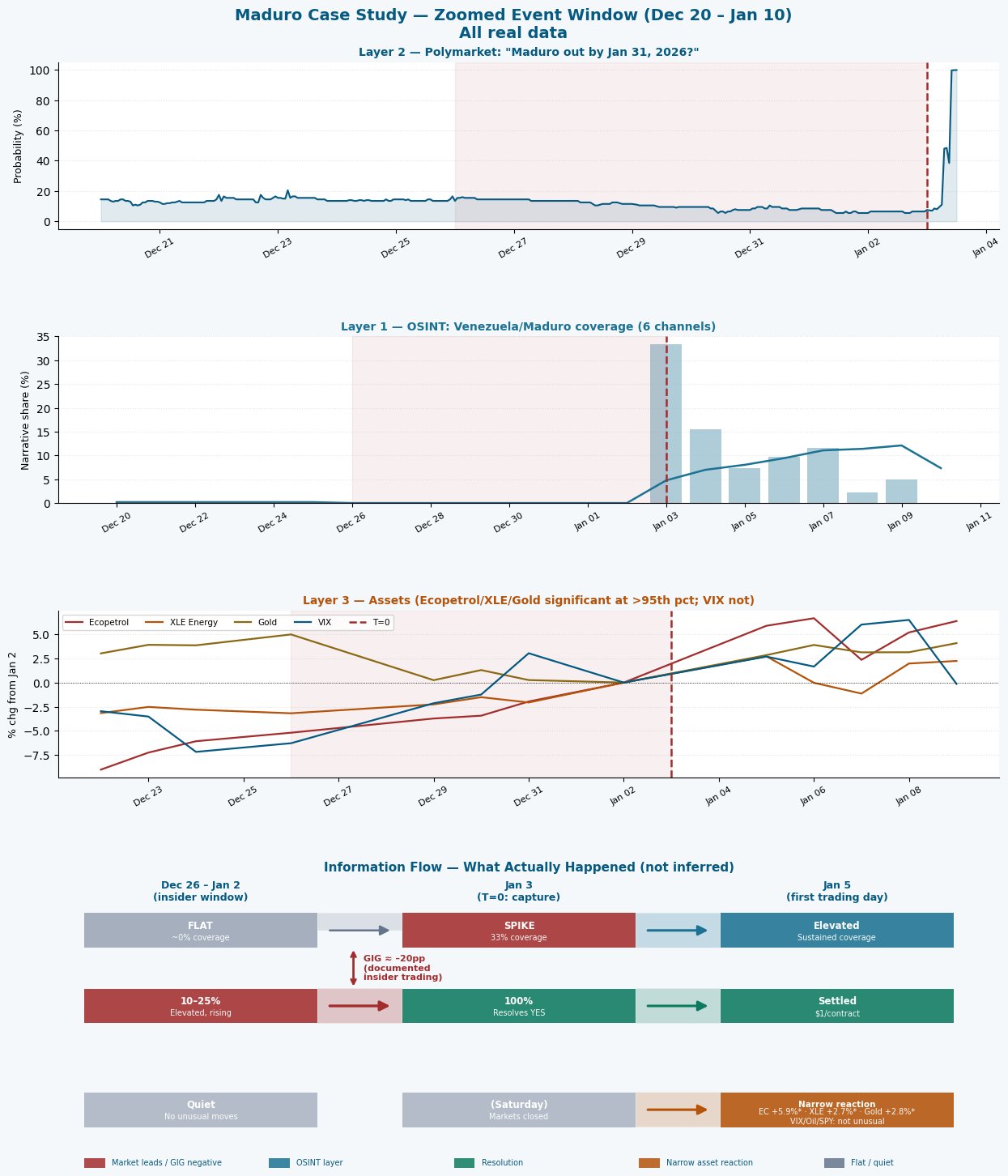
We call that gap — market ahead of narrative — the Geopolitical Information Gap, and it's the core thing CausalAlpha is built to spot.
Who was buying — a few hands, cheap and early
Here is where it gets concrete. The public data feed only shows the most recent ~4,000 trades per market — which, for this one, were all from January 3, the day of the raid. The days before were hidden. So we pulled the complete history straight off the blockchain and finally saw the run-up.
In the days right before the raid, the buying was concentrated, cheap, and early — the signature of conviction, not a crowd:
- The top 10 wallets held about 56% of all the pre-raid "Maduro out" buying.
- Trading ramped from ~85 trades a day in mid-December to ~421 on December 31.
- One wallet spent about $12,300 on ~178,652 "yes" shares at roughly 7 cents, on December 31–January 2. When Maduro was captured, that position was worth about $178,000.
One thing we are careful about: we found a pattern, not a person. These are anonymous wallet addresses. We have not tied any of them to the charged soldier or to anyone else, and we don't call any wallet an "insider." That's a job for funding traces and legal evidence — not for us.
The tell: they bet the one deadline that came true
This is the part that's hard to explain as luck.
At the time, Polymarket wasn't running just one Maduro bet. It was running a whole row of them — same question, will Maduro be gone?, but with different finish lines: by November 30, by December 31, by January 31, and so on.
The raid was January 3. That single date decided which of these bets won and which lost:
Same question, different deadlines
"Gone by November 30?" — No, he was still in power. "Gone by December 31?" — No, and only by three days. "Gone by January 31?" — Yes. That's the one that paid out, and the exact bet named in the indictment.
If the early buying had just been general nerves about Venezuela, you'd expect it spread across all of these bets. It wasn't. In the week before the raid, the confident cheap money landed almost entirely on the one bet whose deadline the raid would actually beat:
| The bet (all ask: will Maduro be gone?) | Deadline | Did it happen by then? | Cheap "yes" buying, week before the raid |
|---|---|---|---|
| Maduro out by Nov 30, 2025 | Nov 30 | No | $0 that week (bet already closed) |
| Maduro out by Dec 31, 2025 — the biggest market | Dec 31 | No — missed by 3 days | ~$14,000 (and ~6-to-1 betting he'd stay) |
| Maduro out by Jan 31, 2026 — the one in the case | Jan 31 | Yes — raid was Jan 3 | ~$64,000 (top 10 wallets = half of it) |
Look at the two middle rows. The bet that won ("by January 31") drew about $64,000 of cheap "yes" buying that week. The near-identical bet that lost by three days ("by December 31") drew only about $14,000 — roughly four to five times less — even though it was the bigger market by far ($34.6M traded, versus $11M). And on that December bet, most people were betting the other way, that he'd stay, by about six to one.
Why this matters: buying the January bet and skipping the December one only makes sense if you knew the timing — that the raid was coming in early January, just after the December deadline passed. Without that knowledge, there's no reason to prefer one over the other; they're the same question a month apart. General excitement buys both. Specific knowledge buys the one that wins.
And the wider markets barely flinched
If a president is captured, shouldn't everything move? Mostly, no. We checked how a basket of assets reacted on the first trading day after the raid, each against its own 2025 history.
Only the narrowly-exposed ones moved unusually: Ecopetrol (Colombia's oil company, +5.9%), the energy sector (+2.7%), and gold (+2.8%). Crude oil itself, the S&P 500, and the market's "fear gauge" (VIX) did not move unusually at all.
That's a localized, sensible reaction — regional energy and a little safe-haven demand — not a market-wide shock. It fits the core finding of our underlying research: at a day-to-day pace, geopolitical signals move the story far more than they move broad prices.
What this means — and what it doesn't
The headline isn't "we caught insiders." It's something more useful and more durable:
Prediction markets are becoming a transparency surface. When information is asymmetric — when someone knows something the public doesn't — it can show up in public, in real time, in the betting. You just need to know how to read it: is the price ahead of the news? Is it a few concentrated hands or a broad crowd? Did the money land on the specific outcome that happened?
That reading is our job. CausalAlpha is a referee, not a tout — we measure how far a market's price runs ahead of the narrative, and how trustworthy that price is, without making accusations or predicting where prices go next. This is a case study, not investment advice.
It's also timely. As lawmakers and regulators debate whether to rein prediction markets in, it's worth remembering what this case shows: the same markets that attract informed trading are also where that trading becomes visible. Opacity hides information asymmetry. A public order book puts it on display.
You can watch these markets the way we do — odds first, with a read on what's broad, what's fragile, and what's moving ahead of the news — on our live prediction-markets board.
This is the plain-language version of an internal case study built entirely on public data: real prediction-market prices, our own news-monitoring corpus, the on-chain trade record, and public asset prices. Every figure traces to a verifiable source. Descriptive only — a pattern, not a verdict on any person.
Get the daily briefing
New research lands here; the daily risk read lands in your inbox after each market close.